Auto Loan Monthly Payments: How the Math Works (2026)
Table of Contents
The One Formula Behind Every Car Payment
Every auto loan uses the standard amortization formula:
M = P × r(1+r)^n / ((1+r)^n − 1)
Three inputs, that is all. P is the principal — the amount you actually finance after the down payment, trade-in equity, taxes, and fees are sorted out. r is the monthly interest rate, which is the APR divided by 12. n is the number of monthly payments (60 for a five-year loan).
The formula does one job: it finds the fixed monthly payment that kills the loan to exactly zero on the final month. That is why your payment never changes even though the split between interest and principal changes every single month. Shrink any of the three inputs — borrow less, get a lower rate, shorten the term — and the payment drops. Stretch any of them and the payment drops too, but the total interest climbs. That tension is the whole game.
A Real 2026 Example, Step by Step
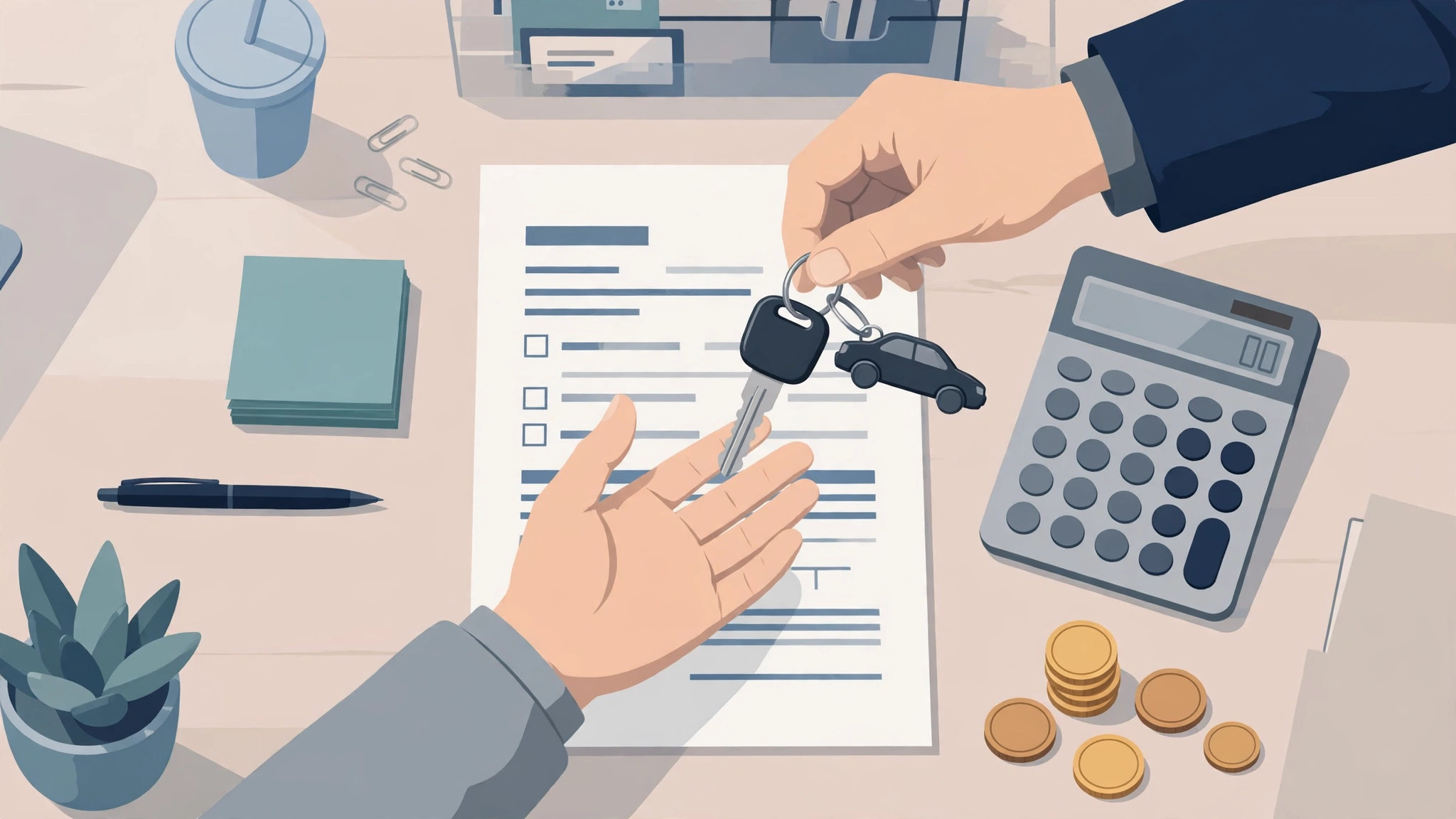
Let us run the formula on a realistic 2026 purchase: a $32,000 car, $4,000 down, 6.9% APR (roughly what borrowers with good credit are seeing this year), 60 months.
Step 1 — Principal. $32,000 − $4,000 = $28,000.
Step 2 — Monthly rate. 0.069 ÷ 12 = 0.00575.
Step 3 — Term. n = 60.
Step 4 — The growth factor. (1.00575)^60 = 1.41059544.
Step 5 — Numerator. $28,000 × 0.00575 × 1.41059544 = $227.11 (rounded).
Step 6 — Denominator. 1.41059544 − 1 = 0.41059544.
Step 7 — Monthly payment. $227.1059 ÷ 0.41059544 = $553.11.
Now the totals. Sixty payments of $553.11 = $33,186.60. Subtract the $28,000 borrowed and you paid $5,186.60 in interest. Add back the $4,000 down payment, and that "$32,000 car" really cost $37,186.60. Keep those three numbers in your head — monthly payment, total interest, total cost — because dealers love talking about only the first one.
Estimate Your Payment Before You Visit the Dealer
Do this at your kitchen table, not in the finance office. The whole exercise takes ten minutes.
1. Get the out-the-door price first. Sticker price is fiction. In most states, sales tax, title, registration, and doc fees land the real number roughly 8–10% above sticker. Email two or three dealers and ask for the out-the-door figure in writing before you discuss financing at all.
2. Subtract your down payment and trade-in equity. Owe $9,000 on your trade and it is worth $12,000? That $3,000 of equity comes straight off the principal. This is your P.
3. Lock in a real APR. Get preapproved by your bank or a credit union before you shop. Dealer-arranged financing is not evil, but a preapproval is a ceiling — if the finance office cannot beat it, you walk with your own rate.
4. Pick a term and run the math. Start with 60 months as your baseline. Divide the APR by 12 for r, count the months for n, and work the formula — or skip the arithmetic and plug the same three numbers into an Auto Loan Calculator, which does the identical calculation instantly.
5. Check the payment against your budget. A common guideline: keep total car costs (payment, insurance, fuel) under about 15% of take-home pay. As a quick sanity check, $30,000 financed at 7% APR for 60 months comes to $594.04 a month — run your own numbers and see where you land before anyone hands you a pen.
Where Your Money Actually Goes Each Month
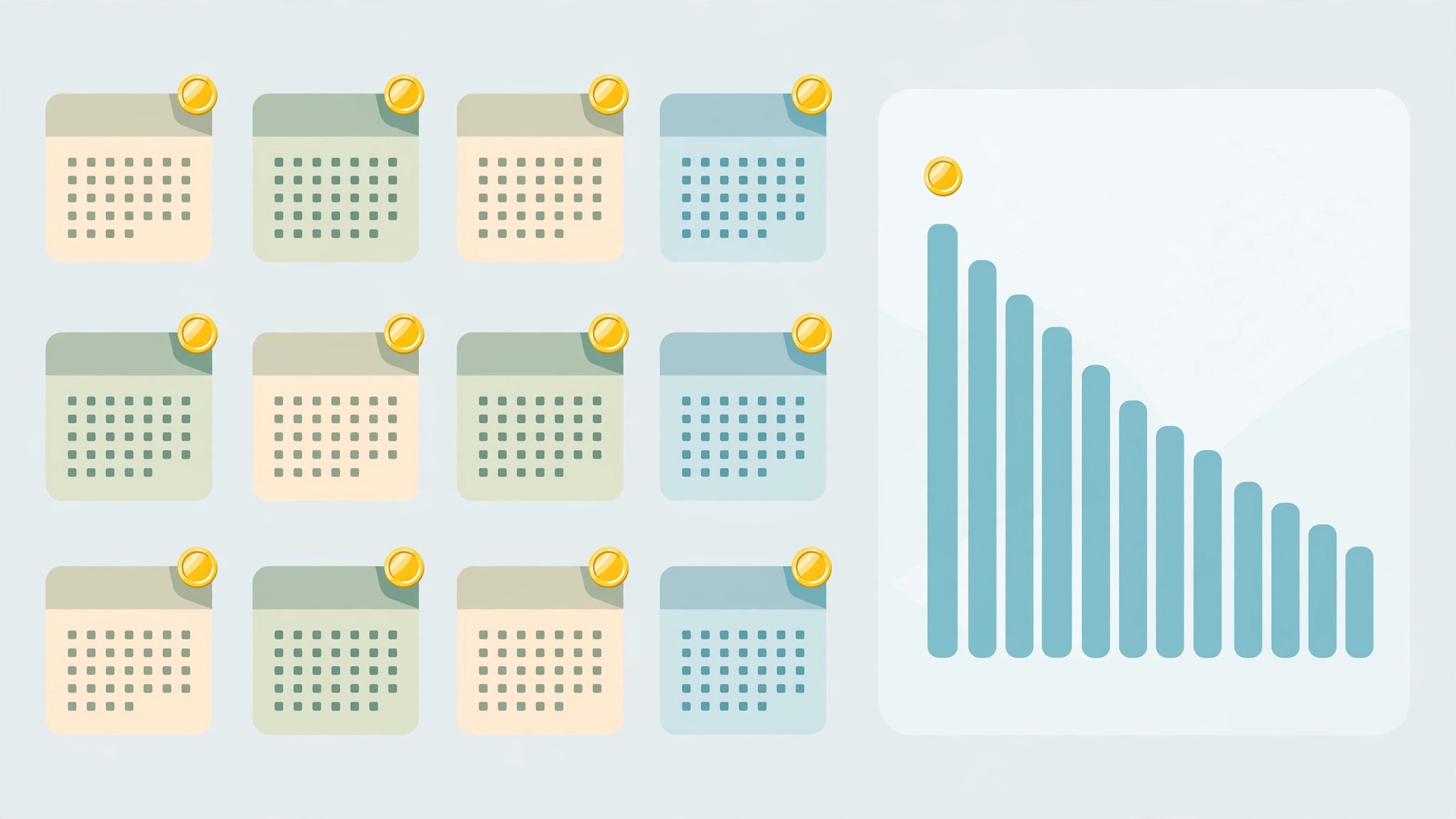
Here is the part most buyers never see. On that $28,000 loan, your first $553.11 payment splits into $161.00 of interest (the balance times 0.00575) and only $392.11 of principal. Nearly a third of your money goes to the lender on day one.
Then the balance starts falling, and the interest charge falls with it. Halfway through the loan, after 30 payments, you still owe $15,201.08 — and payment 31 carries just $87.41 in interest. By the final year, almost the entire $553.11 is principal.
Two lessons hide in there. First, the loan is front-loaded with interest, so any extra principal payment early on saves far more than the same extra payment near the end. Second, when a dealer says "you are only paying a little interest," ask when — because early in the loan, "a little" is $161 a month.
3 Mistakes That Cost Buyers Thousands
Mistake 1: Shopping the monthly payment alone. This is the oldest trick in the finance office. "What monthly payment works for you?" sounds friendly. It is not. Given a long enough term, a dealer can hit any payment — $400, $350 — while quietly inflating the price, padding fees, or stretching the loan. Decide your total budget first, then see what payment it produces. Never the reverse.
Mistake 2: Ignoring total interest. Two loans can have nearly the same payment and wildly different costs. Always multiply: payment × months − principal = the lender's cut. If the worksheet does not show total interest, that is a choice someone made.
Mistake 3: Taking the longest term by default. Stretch our example to 84 months at the same 6.9% APR and the payment falls to $421.23 — a tempting $132 less each month. But total interest jumps to $7,383.32, which is $2,196.72 more than the 60-month loan. A 72-month term lands in between at $476.03 a month and $6,274.16 in interest ($1,087.56 extra). Longer terms also keep you owing more than the car is worth for years — one fender-bender with an underwater loan, and the gap comes out of your pocket.
Three Ways to Shrink Your Payment Without Getting Burned
Put more down. Every $1,000 of extra down payment on our example drops the payment by about $19.75 a month — P falls to $27,000 and the payment becomes $533.36 — and saves $185 in total interest. Small down payments have an outsized payoff.
Fight for the rate. Half a percentage point sounds like nothing. On this loan, 6.4% instead of 6.9% means $546.54 a month instead of $553.11 — and $4,792.40 in total interest versus $5,186.60, a $394 saving for one afternoon of rate shopping. Preapproval from a credit union plus one competing quote is usually enough to get there.
Match the term to the car, not the payment. Sixty months remains the sweet spot for most buyers: affordable payments without the interest bloat of 72- or 84-month loans. If 60 months strains your budget, the honest fix is a cheaper car or a bigger down payment — not a longer loan.
Try it free — no sign-up
Run the numbers yourself in seconds. Everything happens in your browser.
Open the Auto Loan CalculatorFrequently Asked Questions
Does the formula change for biweekly payments?
The formula itself is the same, but n becomes 26 half-payments per year and r becomes the APR divided by 26. The real win with biweekly schedules is behavioral: 26 half-payments equal 13 full monthly payments a year, so you make one extra payment annually without thinking about it, which trims both the term and the total interest.
Why is my first payment mostly interest?
Interest is always charged on the current balance, and the balance is highest at the start. On a $28,000 loan at 6.9% APR, month one accrues $161.00 in interest before a dollar of principal is touched. As the balance shrinks, the interest slice shrinks with it — that is just how amortization works.
How much does a bigger down payment actually lower my payment?
Roughly $19–$20 a month per $1,000 on a 60-month loan near 7% APR. On the worked example, $5,000 down instead of $4,000 takes the payment from $553.11 to $533.36 and saves $185 in interest. The payment drop is modest; the avoided interest and the smaller underwater risk are the bigger prizes.
Are 0% APR dealer offers real?
Yes, but they are narrow: typically 36–48 months, top-tier credit only, and often on specific models the dealer wants to move. Sometimes taking the 0% rate means forfeiting a cash rebate, so compare the 0% offer against the rebate plus your own preapproved rate — the rebate route occasionally wins on total cost.
Should I trust the dealer's payment calculator?
Trust the math, not the source. A calculator is only as honest as its inputs, so confirm the principal includes every fee and add-on, and that the APR and term match what was promised. Running the same numbers yourself in an Auto Loan Calculator that runs entirely in your browser takes thirty seconds and removes all doubt.
Does paying extra each month really save interest?
Yes — every extra dollar goes straight to principal (confirm with your lender that extra payments are applied to principal, not just pushed to next month's due date). Because interest accrues on the balance daily, an extra $50 a month early in the loan compounds into hundreds saved and shaves months off the term.